
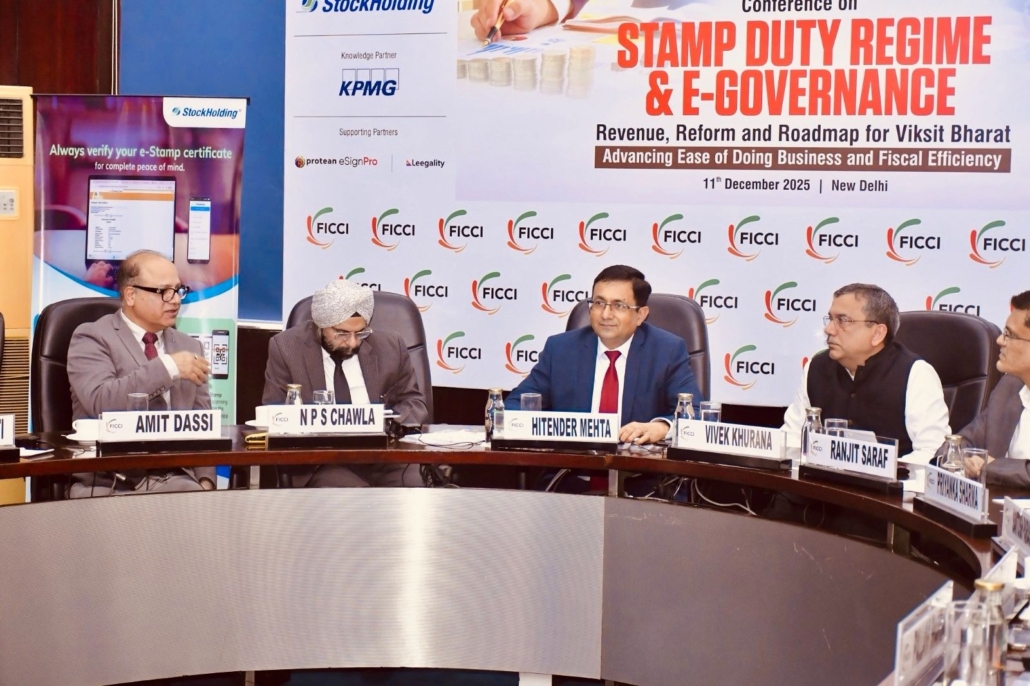


FICCI Conference on Stamp Duty Reforms and e-Governance
Our Managing Partner, Mr. Hitender Mehta, addressed a Conference organized by FICCI on 11 December 2025, focusing on “Stamp Duty Regime & e-Governance: Revenue, Reform and Roadmap for Viksit Bharat.”
The session brought together policymakers, industry experts, and professionals to deliberate on key challenges and reform priorities within India’s stamp duty framework and its role in strengthening governance and ease of doing business.
Key discussion areas and takeaways included:
- Stamp Duty Rationalization: Emphasis on the need to review and rationalize stamp duty rates across property transactions and commercial documentation to reduce transactional costs and improve efficiency.
- Fragmentation and Complexity: Multiple State-level amendments to the Indian Stamp Act, 1899 have resulted in overlapping jurisdictions, interpretational challenges, and increased compliance burdens, impacting the overall business environment.
- Judicial Developments: Recent court rulings on valuation, refunds, and inter-State applicability highlight the need for greater uniformity, digitization, and clarity, particularly for commercial instruments.
- Legislative Reform: The importance of advancing the Indian Stamp Bill, 2023 was underscored, with a focus on achieving national harmonization and modernization, while addressing challenges in coordinated implementation across States.
- Digital Transformation and e-Governance: Adoption of integrated technology platforms, real-time data validation, and interoperable systems can significantly enhance revenue efficiency, transparency, compliance, citizen convenience, and ease of transactions.
- Vision for Viksit Bharat: A digitally enabled, ESG-aligned, and harmonized stamp duty framework is essential to promote ease of doing business, improve ease of living, and strengthen governance across the country.
Mr. Hitender Mehta emphasized the need for a simplified, technology-driven, and uniform regulatory framework to address existing inefficiencies and support India’s growth trajectory.
The conference served as an important platform for dialogue on advancing reforms and building a future-ready stamp duty ecosystem in India.

